
What Makes Sciatica Worse? Common Triggers to Avoid
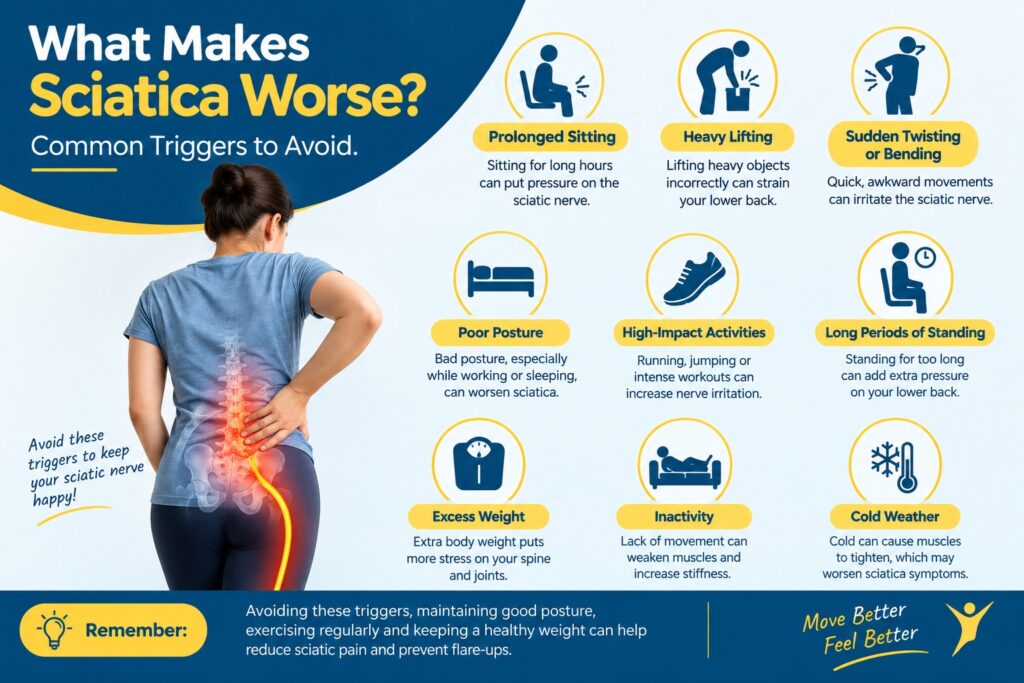
What Makes Sciatica Worse? Common Triggers to Avoid Introduction Sciatica can cause pain that travels from the lower back into the buttock, thigh, or leg. For some people, symptoms may come and go, while others may experience persistent discomfort that affects sitting, walking, sleeping, or everyday activities. Certain movements and daily habits can make these symptoms more noticeable. Understanding common triggers can help you manage your routine and avoid unnecessary strain on the lower back. Why Can Sciatica Pain Become Worse? Sciatica usually occurs when the sciatic nerve is irritated or compressed, often because of problems involving the lower spine. A slipped or herniated disc, narrowing around the spinal nerves, or other spinal changes may contribute to symptoms. The factors that aggravate sciatica are not the same for everyone. A movement that feels comfortable for one person may increase symptoms for another. Paying attention to when pain increases can help identify activities that may need to be modified. Common Triggers That May Aggravate Sciatica Sitting for Long Periods Remaining seated for several hours, particularly without changing position, may increase discomfort in the lower back and legs. This can be common for people who work at a desk or spend long periods travelling. Taking regular movement breaks and changing positions throughout the day can help reduce prolonged pressure and stiffness. Poor Posture and Slouching Slouching while sitting or working can place additional strain on the lower back. An unsuitable chair or poorly arranged workstation may also contribute to discomfort. Keeping the back adequately supported and adjusting the height of your chair and screen can make everyday sitting more comfortable. Sudden Bending, Twisting, or Heavy Lifting Sudden movements can sometimes aggravate an already sensitive lower back. Lifting heavy objects with poor technique may also increase strain. When lifting is necessary, avoid twisting while carrying weight and use controlled movements. If a particular activity consistently increases radiating leg pain, it is better to modify it rather than repeatedly pushing through the discomfort. Doing Too Much Too Soon People may sometimes become more active as soon as their pain starts improving. However, suddenly returning to strenuous exercise, heavy household work, or demanding physical activity can cause symptoms to flare again. A gradual return to activity is generally more appropriate. Your level of activity should be adjusted according to your symptoms and professional advice. Staying Completely Inactive While painful movements may need to be avoided, prolonged bed rest or complete inactivity is not usually helpful for recovery. Gentle movement, when appropriate, can help maintain mobility and prevent excessive stiffness. The goal is to find a balance between avoiding aggravating activities and maintaining safe, comfortable movement. Poor Sleep and Stress Pain can interfere with sleep, and poor sleep may make it harder to cope with ongoing discomfort. Stress and fatigue can also affect how a person experiences pain. Maintaining a regular sleep routine, taking appropriate breaks, and using healthy methods to manage stress may support overall recovery. How Can You Reduce Everyday Sciatica Triggers? Simple changes can make daily activities easier. Avoid staying in one position for too long, use proper posture while working, lift objects carefully, and gradually increase physical activity. If a specific movement repeatedly worsens your symptoms, discuss it with a healthcare professional rather than continuing to test it on your own. When Should You Consider Sciatica Treatment? Occasional back or leg discomfort may improve with appropriate self-care, but persistent, recurring, or worsening symptoms deserve medical evaluation. Sciatica treatment depends on the underlying cause, severity of symptoms, and how the condition is affecting daily life. A proper assessment can help determine whether conservative care, physical rehabilitation, medication, injections, or another treatment approach may be appropriate. Getting evaluated early can also help identify whether another underlying spinal condition is contributing to the symptoms. What Can a Pain Management Specialist Do for Persistent Pain? When pain continues despite changes in activity and routine self-care, a pain management specialist can assess the location, pattern, duration, and severity of the symptoms. This evaluation can help determine whether further investigation or a specific treatment approach may be needed. At ROPS Hospital, patients experiencing persistent back or nerve-related pain can seek an appropriate clinical assessment. Treatment recommendations can then be based on the individual’s symptoms, medical history, and underlying cause rather than applying the same approach to everyone. When Should You Speak to a Pain Management Doctor? Not every episode of sciatica requires specialist care, but recurring pain, increasing symptoms, or discomfort that interferes with work, sleep, walking, or daily activities should not be ignored. A pain management doctor can help assess ongoing symptoms and determine whether additional evaluation or treatment may be appropriate. Seeking medical advice is particularly important when pain does not improve with reasonable self-care or when symptoms continue to interfere with normal activities. When Is Sciatica an Emergency? Some symptoms require urgent medical attention. Seek immediate medical care if sciatica is accompanied by new problems controlling the bladder or bowel, numbness around the inner thighs or genital area, or significant or worsening weakness in the legs. Small Changes Can Make a Difference Sciatica symptoms can sometimes become worse because of prolonged sitting, poor posture, sudden movements, excessive physical activity, or complete inactivity. Identifying your personal triggers and making practical changes to your daily routine can help reduce unnecessary strain. If pain continues, keeps returning, or begins affecting normal activities, professional evaluation can help identify the underlying cause and guide appropriate care.
Why Does Shoulder Pain Get Worse While Sleeping?
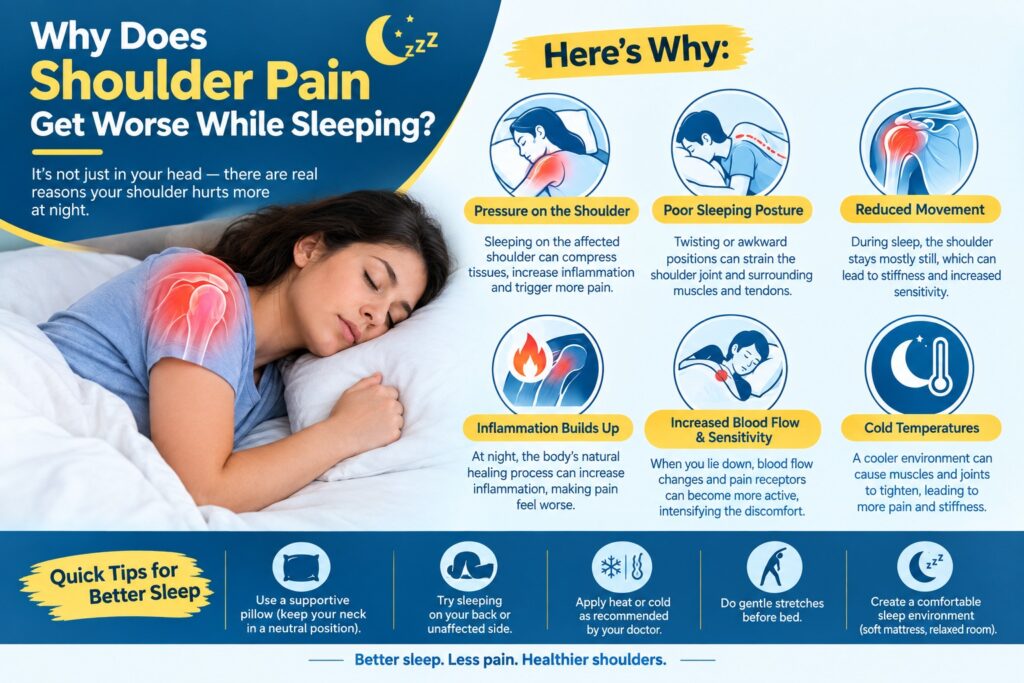
Why Does Shoulder Pain Get Worse While Sleeping? Introduction Shoulder pain can feel more noticeable at night, especially when a person has a frozen shoulder. Pain may make it difficult to find a comfortable sleeping position, stay asleep, or move the arm after waking. The problem can become frustrating because the shoulder may feel manageable during the day but become more uncomfortable after lying down for several hours. Understanding why this happens can help you make practical changes and recognise when professional assessment may be needed. Why Does Frozen Shoulder Hurt More at Night? Frozen shoulder develops when the tissues surrounding the shoulder joint become irritated, tight, and less flexible. This can cause pain along with gradually increasing difficulty moving the arm. At night, lying in one position for a long time may make the shoulder feel stiffer and more uncomfortable. Sleeping directly on the affected side can also place pressure on the painful area. For some people, night-time pain is particularly noticeable during the early, painful stage of frozen shoulder. What Happens to the Shoulder During a Frozen Shoulder? Frozen shoulders do not affect everyone in exactly the same way. Symptoms generally develop gradually and can change as the condition progresses. Painful or Freezing Stage During this stage, shoulder pain may gradually increase and can be particularly troublesome at night. Movement may also become increasingly uncomfortable, making activities such as dressing or reaching overhead more difficult. Stiff or Frozen Stage As stiffness becomes more prominent, the shoulder may have a noticeably reduced range of movement. Reaching behind the back, lifting the arm, or performing routine household activities may become difficult. Recovery or Thawing Stage In the later stage, shoulder movement can gradually improve. The recovery process varies between individuals, and regaining normal movement may take time. Which Sleeping Positions Can Make Shoulder Pain Worse? Sleeping position can have a significant effect on night-time discomfort. Sleeping on the Affected Shoulder Putting your body weight directly on a painful shoulder can increase pressure on the joint and surrounding tissues. If this position increases your pain, try sleeping on the opposite side or on your back. Keeping the Arm Unsupported An unsupported arm may pull the shoulder into a position that feels uncomfortable. Placing a pillow underneath the affected arm can provide support and may make it easier to maintain a comfortable position. Staying in One Position for Too Long Remaining in the same position for several hours can contribute to stiffness. Gentle repositioning during the night, when comfortable, may help prevent the shoulder from remaining in one uncomfortable position for too long. How Can You Sleep More Comfortably With a Frozen Shoulder? A few simple adjustments may make sleeping easier. Try avoiding direct pressure on the painful shoulder and consider supporting the affected arm with a pillow. Some people find sleeping on their back more comfortable, particularly when the arm is properly supported. Gentle exercises recommended by a healthcare professional may also help maintain shoulder movement. However, forceful stretching or repeatedly pushing through significant pain is not advisable without appropriate guidance. Heat or other pain-relief measures may also be considered depending on your individual condition and medical advice. When Should You Consider Frozen Shoulder Treatment? Night-time shoulder pain that continues for weeks, interferes with sleep, or is accompanied by increasing stiffness should be evaluated rather than ignored. Frozen shoulder treatment depends on the stage of the condition, severity of symptoms, range of movement, and the individual’s overall health. Treatment may involve appropriate exercises, physiotherapy, pain-relief measures, or other options when clinically indicated. The most suitable approach should be determined after understanding the underlying cause of the shoulder problem. How Can a Pain Management Doctor Help With Night Pain? If shoulder pain continues despite reasonable changes to sleeping position and daily activities, a pain management doctor can assess the nature and severity of the discomfort. The evaluation may help determine whether the symptoms are related to frozen shoulder or another shoulder condition. At ROPS Hospital, patients with persistent shoulder pain can receive clinical evaluation based on their symptoms and functional difficulties. Understanding the cause of pain is an important part of deciding what type of care may be appropriate. When Should You Seek Medical Evaluation for Shoulder Pain? Not every episode of shoulder pain is caused by frozen shoulder. Persistent pain, significant restriction of movement, repeated sleep disturbance, or symptoms that continue despite self-care should be assessed by a healthcare professional. A pain management physician can review persistent pain, consider the patient’s medical history and previous treatment, and help determine appropriate next steps. Early evaluation can also help distinguish frozen shoulders from other possible causes of shoulder pain. Managing Shoulder Pain for Better Nights Shoulder pain at night can be difficult to manage, particularly when stiffness and discomfort make it hard to find a comfortable sleeping position. Avoiding pressure on the affected shoulder, supporting the arm, maintaining appropriate movement, and seeking professional advice when symptoms persist can help address the problem. If night-time shoulder pain continues or your shoulder movement is becoming increasingly limited, professional evaluation can help identify the underlying cause and guide appropriate care.
Pain Management Myths vs. Facts: What You Really Need to Know
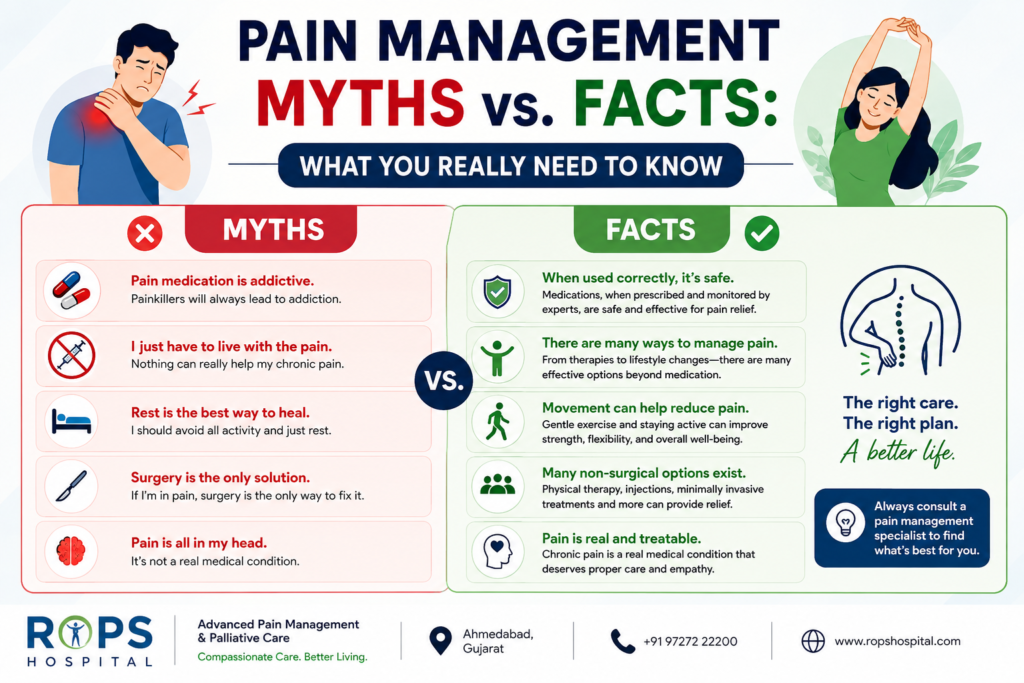
Pain Management Myths vs. Facts: What You Really Need to Know Introduction Chronic pain touches almost every household in one way or another. A father with a stubborn backache. A grandmother whose knees ache before the rain comes. A young professional who’s been living with neck pain since the work from home days began. And, nowadays so much of what people believe about pain is simply not true. These myths don’t just confuse people. They often delay proper treatment, leading many in Gujarat to search for a Best Pain Management Doctor in Ahmedabad only after months, sometimes years, of unnecessary suffering. Dr Jay Panchal from Rops Hospital sees this pattern often. “Patients walk in after trying everything except the one thing that could have helped early on, proper medical guidance,” he says. “Most of that delay comes from myths they’ve picked up along the way.” Myth 1: Pain Is Just Something When You Have to Live With The fact is – The Best Pain Management Doctor in Ahmedabad is a medical condition, not a personality. A Modern pain management offers real, effective options; medications, physiotherapy, minor procedures, and lifestyle changes that can bring genuine relief. Living with pain silently doesn’t make you strong. It just means you’re Not Taking help that already exists. Myth 2: Painkillers Are the Only Solution Many people assume pain treatment begins and ends with a strip of tablets. The truth is more layered. A good treatment plan usually combines a few approaches together. Physiotherapy This helps rebuild strength and movement, especially for joint and back issues. Targeted injections can calm inflammation right at the source, reducing the need for daily medication. Lifestyle adjustments, posture, sleep, weight, and daily movement, often make a bigger difference than people expect. Myth 3: If Surgery Isn’t Recommended, Nothing Else Can Be Done The fact is, most painful conditions never need surgery at all. Doctors reach for surgery only when other options haven’t worked, or when there’s a structural problem that truly requires it. Everything before that stage, medication, therapy, interventional procedures, is designed to manage pain effectively without going anywhere near an operating table. Myth 4: Pain Management Is Only for Old Age Go any clinic today and you’ll see people in their 20s and 30s dealing with chronic Back pain, migraines, or joint discomfort. Desk jobs, long screen hours, poor posture, and inactive lifestyles have brought pain complaints to a much younger crowd. Age isn’t the deciding factor here, how you use (or overuse) your body is. Myth 5: A Pain Specialist Is Only for “Serious” Cases Some people wait until pain becomes turning high before seeking help, thinking mild or moderate pain doesn’t deserve a doctor’s attention. In reality, early consultation is exactly what prevents pain from becoming severe. Catching a problem when it’s manageable is always easier than treating it once it’s taken over daily life. Myth 6: Natural Remedies Are Always Safer Turmeric milk and hot compresses have their place, and they can genuinely help with mild discomfort. But they aren’t a give for medical evaluation when pain is persistent, or affecting your ability to function. Dr Jay Panchal important points out: “The danger isn’t in trying home remedies. It’s in relying on them for months while an underlying issue keeps quietly getting worse.” What This Means for Us Persistent pain deserves proper treatment, not silent tolerance. Treatment usually blends multiple approaches, not just pills. Surgery is the exception, not the rule. Face Age issue with who develops chronic pain. Getting checked early is a smart move, not an wrong anything. If pain has been part of your daily routine like weeks or months, it’s worth when you having a proper conversation with a specialist rather than continuing to guess. At Rops Hospital, Dr Jay Panchal and the team focus on understanding the root cause first, then build proper treatment plan around what actually works for each patient.
Pain Management Options When Surgery Isn’t an Answer
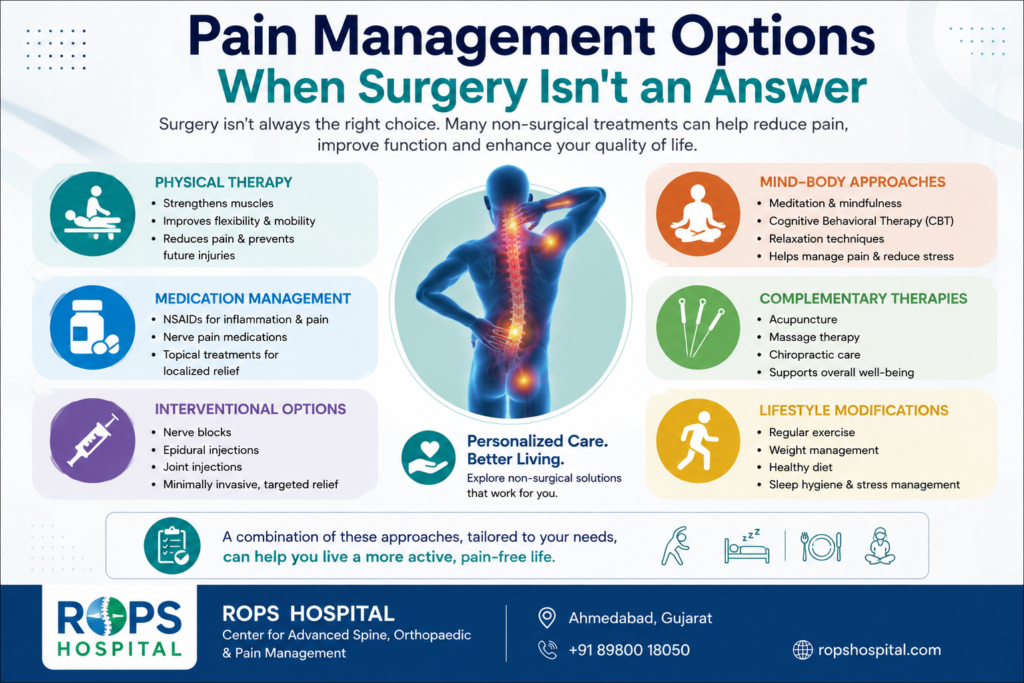
Pain Management Options When Surgery Isn’t an Answer Introduction Living with chronic pain is exhausting physically and mentally. And for many people in Ahmedabad, the assumption is simple: if it hurts long enough, surgery must be the fix. But that’s not always true, and honestly, it’s not always the best first step either. The truth is, a lot of pain conditions respond well to non-surgical treatment. Surgery carries its own risks, recovery time, and cost and in many cases, it’s simply not necessary. This is where a good Pain Management Doctor in Ahmedabad becomes valuable someone who looks beyond “cut it out” and instead asks, “what’s actually causing this, and how can we treat it smartly?” Why Surgery Isn’t Always the Right Call Surgery makes sense for certain structural problems. But for many chronic pain conditions back pain, joint pain, nerve-related pain, arthritis-related discomfort surgery is often a last resort, not a first one. A few reasons doctors often hold off on surgery: Not every pain source is structural. Sometimes nerves, muscles, or inflammation are the real culprits, not something a scalpel can fix. Recovery can be long and uncertain. Some surgeries need months of rehabilitation, and results aren’t guaranteed. Non-surgical options have improved a lot. Modern pain management has more tools than ever before. Dr Jay Panchal often points out that the goal isn’t to avoid surgery out of fear it’s to make sure it’s actually the right tool for the job before committing to it. What Non-Surgical Pain Management Actually Looks Like This isn’t just “take a painkiller and hope for the best.” It’s a structured, layered approach. Medication management Not just popping pills this means figuring out the right combination and dosage to control pain without over-relying on any single medicine. Physical therapy and movement-based treatment Strengthening the muscles around a painful joint or area can reduce strain and pain significantly over time. Movement, done correctly, is often better medicine than rest. Interventional procedures These are minimally invasive treatments things like nerve blocks or targeted injections that can calm down pain signals without needing an operating room. Lifestyle and posture correction A lot of everyday pain (especially back and neck pain) comes from posture, work habits, or how we sit and sleep. Small corrections here often bring noticeable relief. Psychological support for chronic pain Pain isn’t just physical. Long-term pain affects mood, sleep, and stress levels and addressing that side of things genuinely helps physical symptoms too. How a Pain Management Specialist Is Different From a Regular Doctor A general physician treats symptoms broadly. A pain management specialist focuses specifically on understanding why the pain exists and builds a targeted plan around it often combining several of the methods above rather than relying on just one. This is especially useful for conditions like: Chronic back and neck pain Arthritis and joint pain Sciatica and nerve pain Post-injury or post-accident pain Pain that hasn’t responded well to general treatment When Should You See a Pain Management Doctor? You don’t need to wait until pain becomes unbearable. If pain has lasted more than a few weeks, keeps coming back, or is affecting your sleep, work, or mood that’s a reasonable time to get it properly evaluated. At Rops Hospital, the approach tends to focus on this exact idea: understand the root cause first, then choose the least invasive effective treatment. Surgery stays on the table as an option just not the default one. The Bigger Picture Pain management today isn’t about “living with it” or jumping straight to the operating table. It’s about having real options in between and having a doctor who takes the time to explain them clearly, so you can make an informed decision about your own body.
Sciatica (Slipped Disc) Pain: Causes, Symptoms & When You Need a Specialist
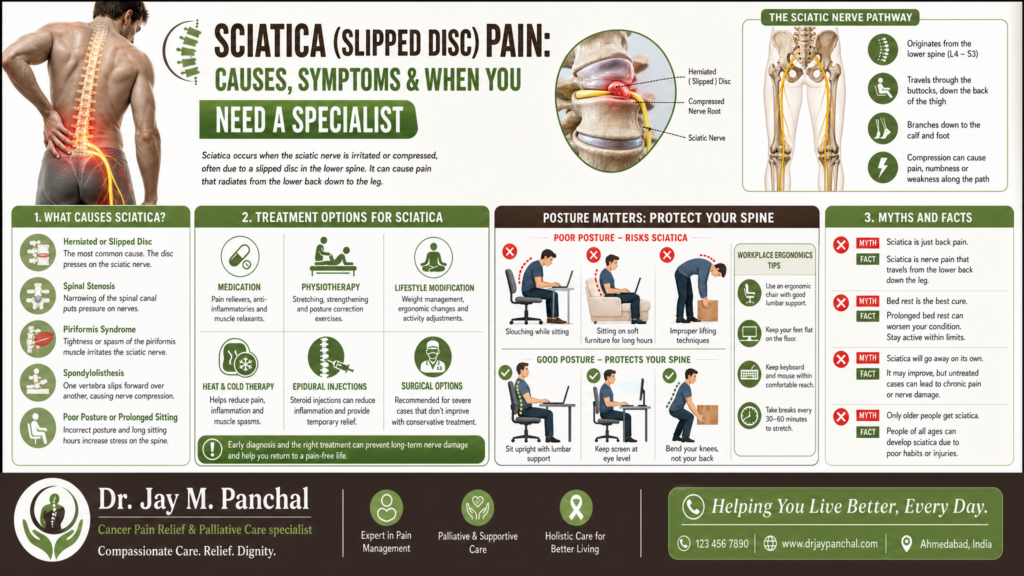
Sciatica (Slipped Disc) Pain: Causes, Symptoms & When You Need a Specialist Introduction If you’ve ever felt a sharp, burning pain shoot from your lower back down through your hip and leg, you may be dealing with sciatica. It’s one of the most common reasons people search for back pain relief — and one of the most misunderstood. Many people either ignore it for too long or panic unnecessarily. This guide breaks down what sciatica actually is, why it happens, what you can do at home, and when it’s time to see a pain management specialist. What Is Sciatica? Sciatica isn’t a disease in itself — it’s a symptom. It refers to pain that travels along the path of the sciatic nerve, the longest and thickest nerve in the body, which runs from your lower back, through your hips and buttocks, and down each leg. When this nerve gets compressed or irritated, usually by a herniated (slipped) disc, bone spur, or narrowing of the spine, it sends pain signals along its entire length. Most people describe sciatica as: – A shooting or burning pain that starts in the lower back or buttock and travels down one leg – Numbness, tingling, or a “pins and needles” sensation in the leg or foot – Muscle weakness in the affected leg – Pain that worsens with sitting, coughing, or sudden movement What Causes Sciatica? The most common cause is a herniated or slipped disc in the lumbar spine, where the soft inner material of a spinal disc pushes out and presses on a nearby nerve root. Other common causes include: – Degenerative disc disease- natural wear and tear of spinal discs with age – Spinal stenosis- narrowing of the spinal canal that puts pressure on nerves – Piriformis syndrome- when a muscle deep in the buttock irritates the sciatic nerve – Spondylolisthesis- when one vertebra slips forward over another – Prolonged sitting, poor posture, obesity, and heavy lifting can all increase your risk How Long Does Sciatica Last? This is one of the most common questions patients ask. In many cases, mild to moderate sciatica improves within **four to six weeks** with rest, activity modification, and conservative treatment. However, if the underlying cause — such as a significant disc herniation — isn’t addressed, symptoms can return or become chronic. Pain lasting longer than six to eight weeks despite treatment usually warrants a proper diagnostic evaluation. Is Walking Good for Sciatica? Yes, in most cases. Gentle walking and light movement are generally better than complete bed rest, which can weaken muscles and slow recovery. However, walking should be low-impact and pain-free — if it aggravates your symptoms, it’s best to stop and consult a specialist rather than pushing through the pain. Can Sciatica Be Cured Permanently? For many patients, especially those with mild nerve irritation, sciatica can resolve completely with the right conservative treatment — physiotherapy, posture correction, weight management, and anti-inflammatory care. In more persistent or recurrent cases caused by structural issues like a significant disc herniation, targeted interventional treatments can provide long-term relief without requiring major surgery. When Is Sciatica a Medical Emergency? While most sciatica cases are manageable, certain symptoms are red flags that need immediate medical attention: – Sudden loss of bladder or bowel control – Numbness in the groin or inner thighs (saddle anesthesia) – Progressive weakness in one or both legs – Severe pain following a fall or injury These symptoms could indicate **cauda equina syndrome**, a rare but serious condition that requires urgent evaluation. How Sciatica Is Diagnosed A pain specialist will typically start with a physical examination, including tests like the straight-leg raise, and review your symptom history. Depending on the findings, imaging such as an MRI may be recommended to identify the exact location and cause of nerve compression — this is essential for planning the right treatment rather than guessing. Treatment Options for Sciatica Treatment is usually approached step by step, starting conservative and escalating only if needed: Rest and activity modification- avoiding movements that worsen pain, without complete inactivity Physiotherapy- targeted exercises to relieve nerve pressure and strengthen supporting muscles Medications- anti-inflammatories or nerve-pain medications to manage symptoms Interventional pain procedures- for patients who don’t respond to conservative care, options like epidural steroid injections or nerve blocks can directly target the source of pain and reduce inflammation around the affected nerve Minimally invasive procedures- in select cases, procedures like endoscopic discectomy can relieve pressure on the nerve with a much shorter recovery time than traditional open surgery Surgery- reserved as a last resort for severe, unresponsive cases or emergency situations The ROPS Hospital Approach At ROPS Hospital, Ahmedabad, Dr. Jay Panchal focuses on identifying the exact source of sciatic pain before recommending treatment, rather than relying on long-term painkiller use. With training in advanced interventional techniques, the focus is always on the least invasive option that provides real, lasting relief — helping patients avoid unnecessary surgery wherever possible. If your sciatica pain has lasted more than a few weeks, keeps returning, or is affecting your daily life, don’t wait it out in silence. A proper diagnosis can make the difference between months of discomfort and a clear path to recovery. Experiencing sciatica or slipped disc symptoms? Book a consultation with Dr. Jay Panchal at ROPS Hospital, Ahmedabad for an accurate diagnosis and personalized treatment plan.
5 Crucial Things Caregivers Should Know About Managing Cancer Pain at Home
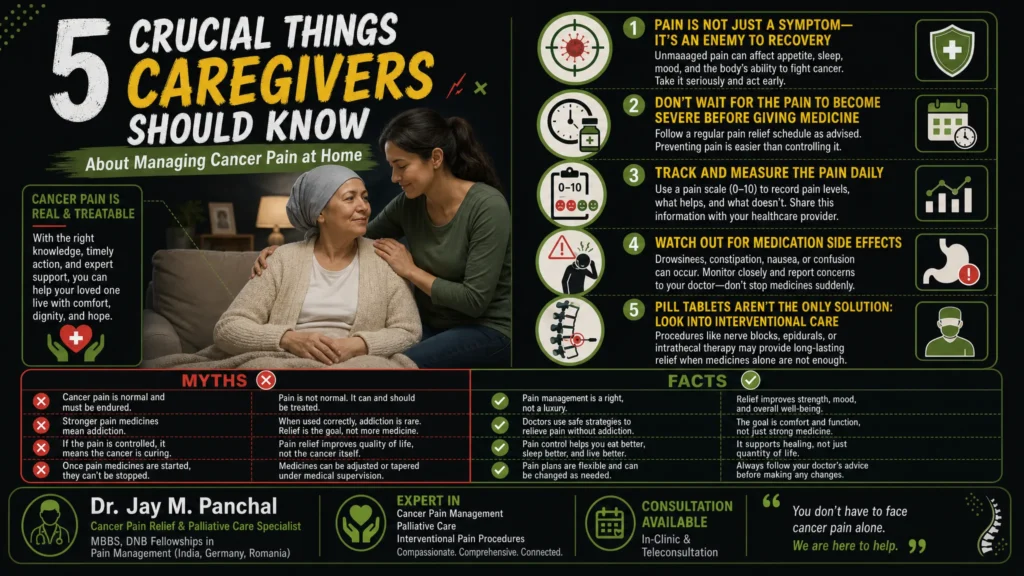
5 Crucial Things Caregivers Should Know About Managing Cancer Pain at Home Introduction Discovering that a loved one has cancer is life-changing. As a caregiver, your days quickly become a whirlwind of doctor appointments, medication schedules, and emotional hurdles. But among all your responsibilities, watching your family member deal with cancer pain is perhaps the hardest part. When a patient returns home from the hospital, managing their comfort falls on your shoulders. Many families feel overwhelmed, believing that severe pain is simply an unavoidable part of the disease. But it doesn’t have to be. Advanced medical care has evolved drastically. To help you navigate this journey with confidence and empathy, here are 5 crucial things every caregiver needs to know about managing cancer pain effectively at home. 1. Pain is Not Just a Symptom—It’s an Enemy to Recovery Many caregivers believe that pain is simply a side effect that must be silently endured while the main cancer treatments (like chemotherapy or radiation) do their work. This is a major misconception. Unmanaged chronic pain drains a patient’s physical strength, disrupts their sleep, causes severe depression, and weakens their immune system. When a patient is in constant agony, their body is under continuous stress, which can actually slow down their overall recovery. Prioritizing pain relief isn’t about “giving up”—it is a core pillar of active healing and preserving their dignity. 2. Don’t Wait for the Pain to Become Severe Before Giving Medicine One of the most common mistakes made at home is waiting for the patient to cry out in pain before administering their prescribed medication. Think of cancer pain like a heavy boulder rolling down a hill; it is much easier to stop it when it first starts moving than to stop it once it has gained full speed. Give long-acting pain medications exactly on the schedule prescribed by your doctor, even if the patient feels okay at that moment. This maintains a steady level of medicine in their system and prevents “breakthrough pain” from spiking. 3. Track and Measure the Pain Daily Pain is highly subjective. What feels like a mild ache to one person might feel intolerable to another. As a caregiver, you are the doctor’s eyes and ears at home. Keeping a simple, daily pain diary can make a massive difference in your loved one’s treatment plan. Use a scale from 0 to 10: Ask your loved one to rate their pain (0 being no pain, 10 being the worst imaginable). Note the timing: When does the pain spike? Is it worse in the morning, after eating, or during movement? Describe the sensation: Is it a dull ache, a sharp burning sensation, or a deep throbbing? Sharing this diary with a specialist helps them fine-tune dosages precisely, ensuring your loved one isn’t over-medicated or left under-treated. 4. Watch Out for Medication Side Effects Strong pain medications, particularly opioids or heavy analgesics, are highly effective but frequently come with side effects. The most common issues include severe constipation, nausea, and drowsiness. Many patients stop taking their vital pain medications because the side effects feel worse than the pain itself. Never let them stop their medication abruptly. Instead, speak to your clinical team. Side effects are manageable with simple adjustments, dietary changes, or secondary prescriptions. 5. Pill Tablets Aren’t the Only Solution: Look into Interventional Care When oral medications cause immense nausea, or when maximum doses fail to provide relief, families often feel helpless. This is exactly where interventional pain management and parallel palliative care come into play. Modern medicine offers advanced, minimally invasive procedures like neurolytic nerve blocks or intrathecal drug delivery systems. These techniques target the pain right at the source—the affected nerve level—without passing heavily through the digestive system. This means maximum comfort with a fraction of the side effects. If you are looking for advanced guidance to bring your loved one comfort, consulting with the best pain management doctor in Ahmedabad can open doors to these highly specialized, non-surgical relief options. Experienced experts, such as those at dedicated centres like ROPS Hospital, understand how to carefully design personalized therapies that vastly improve a patient’s quality of life. Myths vs. Facts: The Truth About Sciatica To help clear the air around common fears families face in India, let’s break down a few widespread misconceptions: Myth Fact Myth: Using strong pain medications like morphine means the patient is in their final days. Fact: Morphine and advanced nerve blocks are used at any stage of cancer to control severe pain, allowing patients to stay strong, mobile, and active during their treatments. Myth: Cancer patients will easily get addicted to prescription pain killers. Fact: When taken exactly as directed under the strict supervision of a qualified expert, physical addiction is incredibly rare. The body utilizes the medicine purely to counteract biological pain signals. Myth: Pain is just a mental thing, and patients should practice strong willpower. Fact: Cancer pain is entirely real, biological, and caused by tumors pressing against bones, organs, or nerves. Willpower cannot cure nerve inflammation; targeted medical care can. The Takeaway: You Do Not Have to Go Through This Alone Being a caregiver is an act of profound love, but you don’t have to carry the medical burden by yourself. If standard prescriptions aren’t keeping your loved one comfortable, don’t hesitate to seek a second opinion. Reaching out to a specialized clinic or consulting the best pain management doctor in Ahmedabad can give you the tools, procedures, and support needed to bring peace, comfort, and smiles back into your home. Conclusion Managing cancer pain at home can feel like a daunting responsibility, but it is one of the most impactful ways you can support your loved one. Remember, keeping them pain-free isn’t a luxury, it is a medical necessity that preserves their strength, boosts their mental well-being, and allows them to fight their illness with dignity. You do not have to navigate this challenging path in isolation. If everyday medications are falling short, or if the
The Sitting Epidemic: How Your Desk Job is Secretly Triggering Your Sciatica Pain
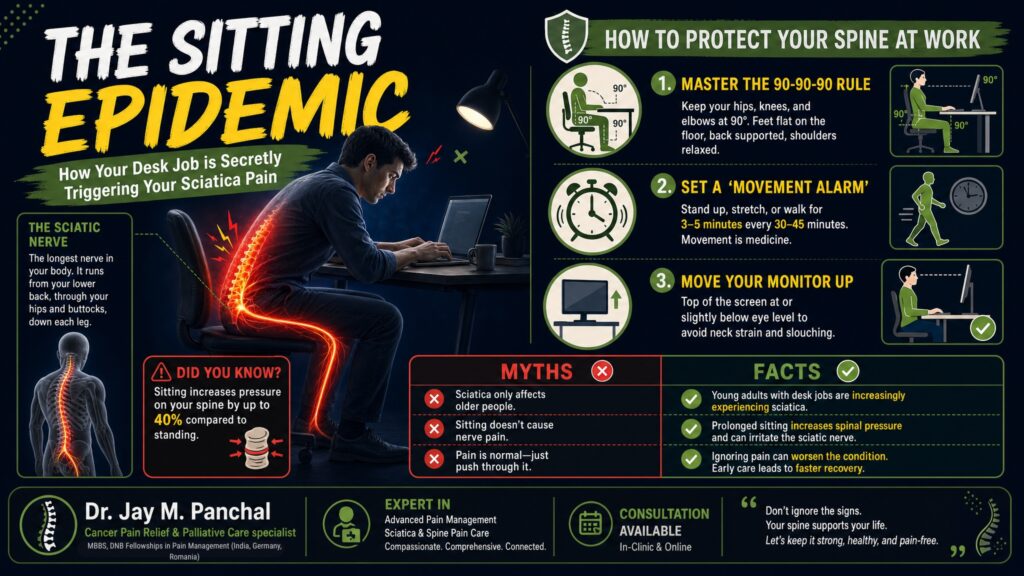
The Sitting Epidemic: How Your Desk Job is Secretly Triggering Your Sciatica Pain Introduction Imagine this: You’ve been sitting at your desk for three hours straight, deeply focused on finishing a project. As you finally stand up to grab a cup of coffee, a sharp, electric shock of pain shoots from your lower back, travels straight through your glutes, and fires down the back of your leg. You try to stretch it out, thinking it’s just a simple muscle catch. But day after day, that dull, throbbing ache returns, making it impossible to sit comfortably. If this sounds familiar, you aren’t just experiencing everyday work fatigue. You might be dealing with sciatica and your modern desk job might be the silent culprit behind it. Let’s break down exactly how prolonged sitting damages your spine and, most importantly, how you can fix it without jumping straight to surgery. The Anatomy of the Ache: What is Sciatica? To understand why sitting is so destructive, we first need to look at the anatomy. The sciatic nerve is the longest and thickest nerve in your entire body. It originates in your lower back, runs through your hips and buttocks, and branches down each leg. When everything is aligned perfectly, you don’t even notice it. But if something presses against this nerve, it sends severe, radiating pain signals down its path. When you sit at a desk for 8 to 10 hours a day, several structural changes happen to your body: The Slipped Disc Trigger: Slouching forward at a desk creates a massive amount of uneven pressure on your lumbar spine. Over time, this pressure can cause the soft cushions between your vertebrae to bulge or herniate (a slipped disc), directly pinching the sciatic nerve root. Piriformis Syndrome: Prolonged sitting compresses the piriformis muscle located deep in your buttocks. When this muscle tightens and spasms from lack of movement, it traps the sciatic nerve underneath it, mimicking true sciatica. Hip Flexor Tightness: Sitting keeps your hips in a constantly flexed position. This shortens your hip muscles, pulls your pelvis out of alignment, and forces your lower back to overcompensate, adding further stress to the spine. Signs Your Desk Posture is Crossing into the Sciatica Danger Zone How do you know if your routine back fatigue is turning into chronic sciatica? Watch out for these distinct warning signs: The pain is strictly on one side of your lower body. Sitting down worsens the pain significantly, while walking or standing offers mild relief. The sensation isn’t just a muscle ache; it feels like a sharp burn, an electric shock, or a constant deep throb. You experience numbness, tingling, or a “pins and needles” sensation in your calf or foot. Myths vs. Facts: The Truth About Sciatica Because spine pain is so common in Indian households, there is plenty of well-meaning but harmful advice passed around. Let’s clear up the confusion: Myth Fact Myth: Complete, strict bed rest is the absolute best way to heal sciatica. Fact: Prolonged bed rest actually stiffens your muscles, weakens your core, and can prolong nerve irritation. Gentle, targeted movement and light walking are much better for recovery. Myth: Heavy, traditional oil massages can massage away the nerve pain. Fact: Aggressive, deep-tissue local massages on an inflamed sciatic nerve can drastically increase swelling and worsen the nerve compression. Myth: If you have sciatica, you will eventually need major spine surgery. Fact: Over 90% of sciatica cases can be successfully managed without major surgery through advanced interventional pain procedures and structured physical therapy. Desk First-Aid: How to Protect Your Spine at Work You don’t have to quit your job to save your back. Making a few conscious adjustments to your daily routine can dramatically reduce the pressure on your sciatic nerve: Master the 90-90-90 Rule Adjust your office chair so that your knees are at a 90-degree angle, your hips are at a 90-degree angle, and your elbows rest comfortably at 90 degrees on your desk. Keep your feet flat on the floor; crossing your legs tilts your pelvis and immediately pinches your lower back nerves. Set a “Movement Alarm” Your spine thrives on movement. Set a timer on your phone for every 45 minutes. When it goes off, stand up for just 2 minutes. Do a gentle standing backward bend, roll your shoulders, or walk to get water. This breaks the continuous compression on your lumbar discs. Move Your Monitor Up If you are looking down at a laptop screen, your entire spine rounds forward to accommodate your gaze. Elevate your monitor to eye level using a laptop stand or a stack of books so your spine stays naturally upright. When Ergonomics Isn’t Enough: Finding the Right Help If you have already tried changing your chair, applying heating pads, and taking over-the-counter pain relievers, but the shooting leg pain still persists, it’s time to stop guessing. Ignoring chronic nerve compression can lead to long-term nerve damage. Fortunately, modern medicine bridges the gap between basic home care and invasive surgery. Advanced techniques such as epidural steroid injections, selective nerve root blocks, and radiofrequency ablation can precisely target and switch off the pain signals at the source, allowing your body to heal naturally. If you are struggling to find lasting relief from chronic shooting pain, seeking specialized sciatica treatment in Ahmedabad can help you pinpoint the exact root cause of your discomfort. Consulting an expert at a dedicated facility like ROPS Hospital ensures you receive a personalized, non-surgical treatment plan designed to get you out of your painful chair and back to living your life to the fullest. Conclusion Your desk job might be a professional necessity, but living in constant, shooting agony doesn’t have to be. Sciatica is your body’s loud warning system telling you that your spine is under severe duress. By breaking the cycle of prolonged sitting, correcting your desk ergonomics, and knowing when to consult a specialist for advanced interventional care, you can put an end to the sitting epidemic