The Sitting Epidemic: How Your Desk Job is Secretly Triggering Your Sciatica Pain
Introduction
Imagine this: You’ve been sitting at your desk for three hours straight, deeply focused on finishing a project. As you finally stand up to grab a cup of coffee, a sharp, electric shock of pain shoots from your lower back, travels straight through your glutes, and fires down the back of your leg. You try to stretch it out, thinking it’s just a simple muscle catch.
But day after day, that dull, throbbing ache returns, making it impossible to sit comfortably.
If this sounds familiar, you aren’t just experiencing everyday work fatigue. You might be dealing with sciatica and your modern desk job might be the silent culprit behind it. Let’s break down exactly how prolonged sitting damages your spine and, most importantly, how you can fix it without jumping straight to surgery.
The Anatomy of the Ache: What is Sciatica?
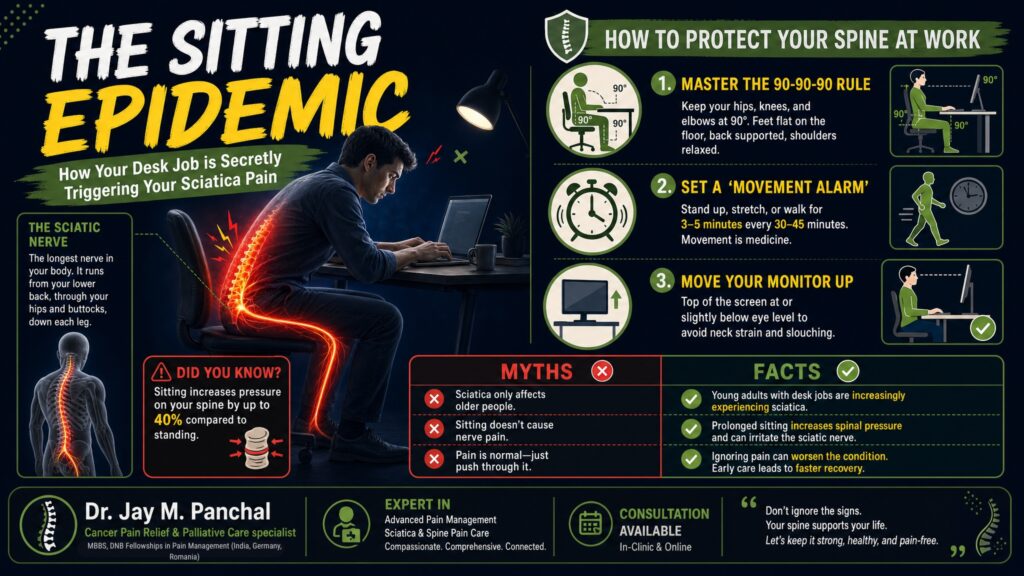
To understand why sitting is so destructive, we first need to look at the anatomy. The sciatic nerve is the longest and thickest nerve in your entire body. It originates in your lower back, runs through your hips and buttocks, and branches down each leg.
When everything is aligned perfectly, you don’t even notice it. But if something presses against this nerve, it sends severe, radiating pain signals down its path.
When you sit at a desk for 8 to 10 hours a day, several structural changes happen to your body:
- The Slipped Disc Trigger: Slouching forward at a desk creates a massive amount of uneven pressure on your lumbar spine. Over time, this pressure can cause the soft cushions between your vertebrae to bulge or herniate (a slipped disc), directly pinching the sciatic nerve root.
- Piriformis Syndrome: Prolonged sitting compresses the piriformis muscle located deep in your buttocks. When this muscle tightens and spasms from lack of movement, it traps the sciatic nerve underneath it, mimicking true sciatica.
- Hip Flexor Tightness: Sitting keeps your hips in a constantly flexed position. This shortens your hip muscles, pulls your pelvis out of alignment, and forces your lower back to overcompensate, adding further stress to the spine.
Signs Your Desk Posture is Crossing into the Sciatica Danger Zone
How do you know if your routine back fatigue is turning into chronic sciatica? Watch out for these distinct warning signs:
- The pain is strictly on one side of your lower body.
- Sitting down worsens the pain significantly, while walking or standing offers mild relief.
- The sensation isn’t just a muscle ache; it feels like a sharp burn, an electric shock, or a constant deep throb.
- You experience numbness, tingling, or a “pins and needles” sensation in your calf or foot.
Myths vs. Facts: The Truth About Sciatica
Because spine pain is so common in Indian households, there is plenty of well-meaning but harmful advice passed around. Let’s clear up the confusion:
Myth | Fact |
Myth: Complete, strict bed rest is the absolute best way to heal sciatica. | Fact: Prolonged bed rest actually stiffens your muscles, weakens your core, and can prolong nerve irritation. Gentle, targeted movement and light walking are much better for recovery. |
Myth: Heavy, traditional oil massages can massage away the nerve pain. | Fact: Aggressive, deep-tissue local massages on an inflamed sciatic nerve can drastically increase swelling and worsen the nerve compression. |
Myth: If you have sciatica, you will eventually need major spine surgery. | Fact: Over 90% of sciatica cases can be successfully managed without major surgery through advanced interventional pain procedures and structured physical therapy. |
Desk First-Aid: How to Protect Your Spine at Work
You don’t have to quit your job to save your back. Making a few conscious adjustments to your daily routine can dramatically reduce the pressure on your sciatic nerve:
- Master the 90-90-90 Rule
Adjust your office chair so that your knees are at a 90-degree angle, your hips are at a 90-degree angle, and your elbows rest comfortably at 90 degrees on your desk. Keep your feet flat on the floor; crossing your legs tilts your pelvis and immediately pinches your lower back nerves.
- Set a “Movement Alarm”
Your spine thrives on movement. Set a timer on your phone for every 45 minutes. When it goes off, stand up for just 2 minutes. Do a gentle standing backward bend, roll your shoulders, or walk to get water. This breaks the continuous compression on your lumbar discs.
- Move Your Monitor Up
If you are looking down at a laptop screen, your entire spine rounds forward to accommodate your gaze. Elevate your monitor to eye level using a laptop stand or a stack of books so your spine stays naturally upright.
When Ergonomics Isn't Enough: Finding the Right Help
If you have already tried changing your chair, applying heating pads, and taking over-the-counter pain relievers, but the shooting leg pain still persists, it’s time to stop guessing. Ignoring chronic nerve compression can lead to long-term nerve damage.
Fortunately, modern medicine bridges the gap between basic home care and invasive surgery. Advanced techniques such as epidural steroid injections, selective nerve root blocks, and radiofrequency ablation can precisely target and switch off the pain signals at the source, allowing your body to heal naturally.
If you are struggling to find lasting relief from chronic shooting pain, seeking specialized sciatica treatment in Ahmedabad can help you pinpoint the exact root cause of your discomfort. Consulting an expert at a dedicated facility like ROPS Hospital ensures you receive a personalized, non-surgical treatment plan designed to get you out of your painful chair and back to living your life to the fullest.
Conclusion
Your desk job might be a professional necessity, but living in constant, shooting agony doesn’t have to be. Sciatica is your body’s loud warning system telling you that your spine is under severe duress. By breaking the cycle of prolonged sitting, correcting your desk ergonomics, and knowing when to consult a specialist for advanced interventional care, you can put an end to the sitting epidemic and reclaim a pain-free life.