
Sciatica (Slipped Disc) Pain: Causes, Symptoms & When You Need a Specialist
Introduction
If you’ve ever felt a sharp, burning pain shoot from your lower back down through your hip and leg, you may be dealing with sciatica. It’s one of the most common reasons people search for back pain relief — and one of the most misunderstood. Many people either ignore it for too long or panic unnecessarily. This guide breaks down what sciatica actually is, why it happens, what you can do at home, and when it’s time to see a pain management specialist.
What Is Sciatica?
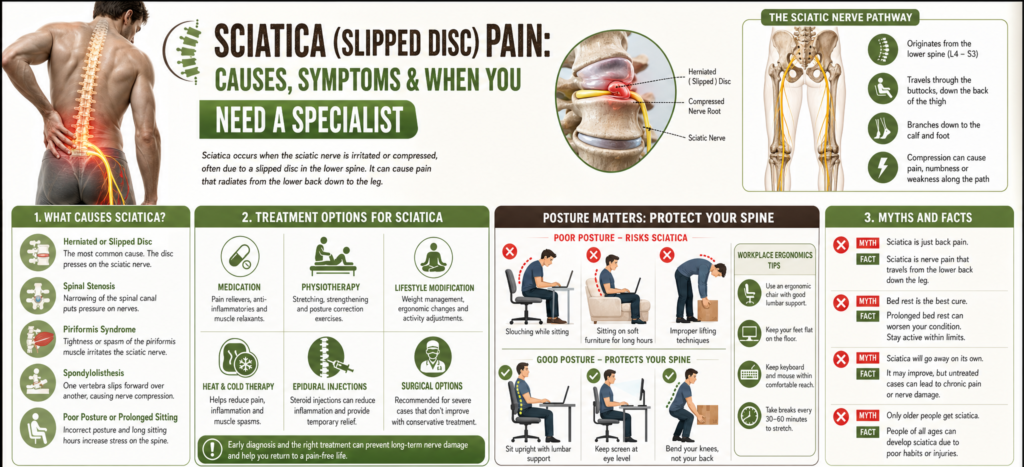
Sciatica isn’t a disease in itself — it’s a symptom. It refers to pain that travels along the path of the sciatic nerve, the longest and thickest nerve in the body, which runs from your lower back, through your hips and buttocks, and down each leg. When this nerve gets compressed or irritated, usually by a herniated (slipped) disc, bone spur, or narrowing of the spine, it sends pain signals along its entire length.
Most people describe sciatica as:
– A shooting or burning pain that starts in the lower back or buttock and travels down one leg
– Numbness, tingling, or a “pins and needles” sensation in the leg or foot
– Muscle weakness in the affected leg
– Pain that worsens with sitting, coughing, or sudden movement
What Causes Sciatica?
The most common cause is a herniated or slipped disc in the lumbar spine, where the soft inner material of a spinal disc pushes out and presses on a nearby nerve root. Other common causes include:
– Degenerative disc disease- natural wear and tear of spinal discs with age
– Spinal stenosis- narrowing of the spinal canal that puts pressure on nerves
– Piriformis syndrome- when a muscle deep in the buttock irritates the sciatic nerve
– Spondylolisthesis- when one vertebra slips forward over another
– Prolonged sitting, poor posture, obesity, and heavy lifting can all increase your risk
How Long Does Sciatica Last?
This is one of the most common questions patients ask. In many cases, mild to moderate sciatica improves within **four to six weeks** with rest, activity modification, and conservative treatment. However, if the underlying cause — such as a significant disc herniation — isn’t addressed, symptoms can return or become chronic. Pain lasting longer than six to eight weeks despite treatment usually warrants a proper diagnostic evaluation.
Is Walking Good for Sciatica?
Yes, in most cases. Gentle walking and light movement are generally better than complete bed rest, which can weaken muscles and slow recovery. However, walking should be low-impact and pain-free — if it aggravates your symptoms, it’s best to stop and consult a specialist rather than pushing through the pain.
Can Sciatica Be Cured Permanently?
For many patients, especially those with mild nerve irritation, sciatica can resolve completely with the right conservative treatment — physiotherapy, posture correction, weight management, and anti-inflammatory care. In more persistent or recurrent cases caused by structural issues like a significant disc herniation, targeted interventional treatments can provide long-term relief without requiring major surgery.
When Is Sciatica a Medical Emergency?
While most sciatica cases are manageable, certain symptoms are red flags that need immediate medical attention:
– Sudden loss of bladder or bowel control
– Numbness in the groin or inner thighs (saddle anesthesia)
– Progressive weakness in one or both legs
– Severe pain following a fall or injury
These symptoms could indicate **cauda equina syndrome**, a rare but serious condition that requires urgent evaluation.
How Sciatica Is Diagnosed
A pain specialist will typically start with a physical examination, including tests like the straight-leg raise, and review your symptom history. Depending on the findings, imaging such as an MRI may be recommended to identify the exact location and cause of nerve compression — this is essential for planning the right treatment rather than guessing.
Treatment Options for Sciatica
Treatment is usually approached step by step, starting conservative and escalating only if needed:
- Rest and activity modification- avoiding movements that worsen pain, without complete inactivity
- Physiotherapy- targeted exercises to relieve nerve pressure and strengthen supporting muscles
- Medications- anti-inflammatories or nerve-pain medications to manage symptoms
- Interventional pain procedures- for patients who don’t respond to conservative care, options like epidural steroid injections or nerve blocks can directly target the source of pain and reduce inflammation around the affected nerve
- Minimally invasive procedures- in select cases, procedures like endoscopic discectomy can relieve pressure on the nerve with a much shorter recovery time than traditional open surgery
- Surgery- reserved as a last resort for severe, unresponsive cases or emergency situations
The ROPS Hospital Approach
At ROPS Hospital, Ahmedabad, Dr. Jay Panchal focuses on identifying the exact source of sciatic pain before recommending treatment, rather than relying on long-term painkiller use. With training in advanced interventional techniques, the focus is always on the least invasive option that provides real, lasting relief — helping patients avoid unnecessary surgery wherever possible.
If your sciatica pain has lasted more than a few weeks, keeps returning, or is affecting your daily life, don’t wait it out in silence. A proper diagnosis can make the difference between months of discomfort and a clear path to recovery.
Experiencing sciatica or slipped disc symptoms? Book a consultation with Dr. Jay Panchal at ROPS Hospital, Ahmedabad for an accurate diagnosis and personalized treatment plan.